
Public Speaking for Kids: Turn Shy Kids Into Confident Speakers
Public speaking for kids is not just standing on a stage with a microphone. It includes school presentations, lemonade stand sales pitches, interviews, group discussions, and everyday conversations where children learn to communicate ideas clearly.
Key Takeaways
- Public speaking is a learned life skill that builds confidence, leadership, and clear communication in children.
- Games and fun activities build public speaking skills by making the process feel natural and engaging.
- Structured practice at home, in school, through online public speaking classes, and in programs like Lemonade Day helps children become confident communicators over time.
- Kids do not need to stop feeling nervous to improve; they need a supportive environment, practice, and constructive feedback.
- Lemonade Day gives children real-world practice speaking to customers while learning entrepreneurship and money skills.
Why Public Speaking Matters for Kids in 2026

Public speaking for kids usually means ages 5–14 learning to present ideas, answer questions, and speak with purpose. In 2026, it belongs beside reading and math because good communication affects almost every part of a child's confidence, academic performance, and future opportunities.
Strong communication skills help with class reports, school presentations, group projects, student council campaigns, and later college or job interviews. Many schools now assess presentation skills with rubrics that look at speech structure, eye contact, body language, clarity, and audience engagement. Research on elementary public speaking training found that students improved in organization and nonverbal delivery after structured lessons, even when anxiety did not disappear completely (ScienceDirect).
Public speaking also supports leadership skills. A child who can explain ideas clearly is more likely to participate actively, lead a team, ask thoughtful questions, and take leadership roles in clubs or community projects. Practicing public speaking helps children improve their communication skills, which are essential for personal growth and future career prospects.
How Public Speaking Helps Children Learn and Thrive
Speaking skills shape how children learn in everyday life. When kids explain a story, describe a science experiment, or defend an opinion, they must organize thoughts and listen carefully to others.
Public speaking improves children's presentation skills, teaching them how to organize their thoughts and create engaging presentations, which are useful in both academic and professional settings. It can also support reading comprehension, writing organization, and test-taking confidence. Putting ideas into words helps students clarify critical thinking in science, history, and math.
The emotional benefits matter too. Commonly cited estimates suggest that 75% of the population has public speaking anxiety, and 90% of people with social anxiety disorder fear public speaking. Children learn that they can feel nervous, breathe, recover from mistakes, and keep going. For example, a 4th grader who practices a one-minute book talk at home each night may return to class with better volume, clearer examples, and more confidence answering questions.
Encouraging children to speak in public helps them develop good communication skills, which are essential for their overall development and future opportunities.
Age-by-Age Guide: Public Speaking for Kids from Kindergarten to Middle School
Children can start developing basic public speaking abilities as young as 5 or 6 years old, with the complexity of training adjusted to their readiness. Public speaking is a skill built through play, comfort, and gradual exposure.
For early elementary students in grades K–2, keep speaking simple and playful. Ask children to do show-and-tell, read a favorite picture book aloud, or explain how they built a Lego model. Practicing public speaking from a young age broadens a child's vocabulary and strengthens their ability to communicate confidently.
For grades 3–5, kids learn best through short speeches, simple debates like "cats vs. dogs," and explaining the steps of a science experiment. Public speaking classes for kids are designed to help children develop confidence and skills necessary to deliver effective and impactful speeches, particularly for students in grades 3 to 8.
For grades 6–8, try structured presentations, a mini ted talk on a passion topic, or persuasive speeches about school issues. Encourage children to choose interest-led topics for presentations to enhance engagement. Shy children at every stage need small audiences, low-stakes topics, and praise for effort instead of perfection.
Core Public Speaking Skills Kids Need (and How to Teach Them)
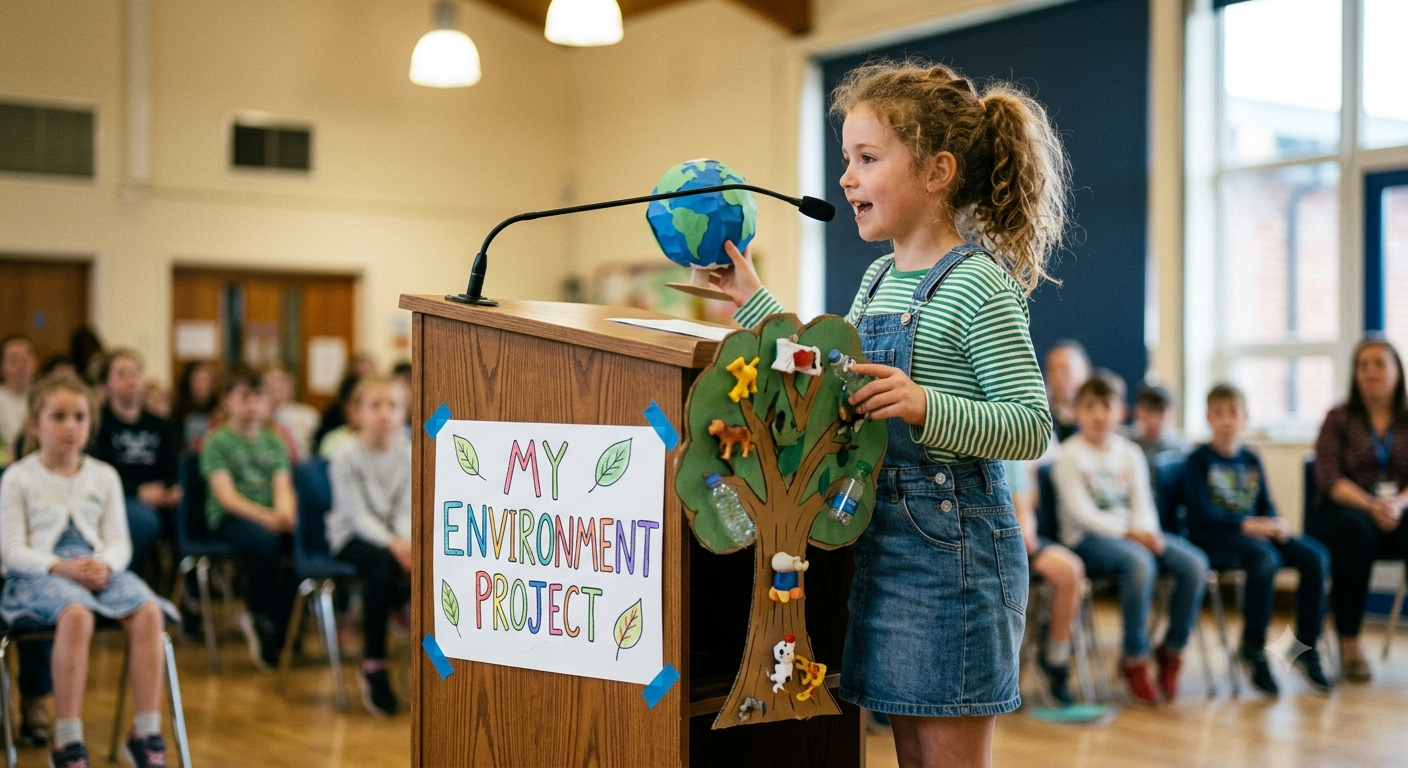
Great child speakers balance content, or what they say, with delivery, or how they say it. A well organized speech has a beginning, middle, and end, plus one or two stories, examples, or facts.
Delivery includes positive body language, eye contact, facial expressions, and vocal control. Eye contact and volume control are key aspects of effective public speaking for children. The 5 P's framework includes Pitch, Pace, Pause, Projection, and Passion, which are essential for effective speaking.
Here are simple public speaking techniques adults can teach
- Record a 1-minute speech on a phone and ask the child what they notice.
- Play the "one-minute challenge" where kids explain a snack, game, or hobby in exactly 60 seconds.
- Use props because using props helps shift their focus away from stage fright and lets them practice voice modulation.
- Give one strength and one next step, such as, "You smiled at the audience; next time, slow your pace."
The goal is not instant perfection. With the right guidance, children develop stronger speaking skills, stage presence, and the ability to engage audiences over time.
Practical Tips: How to Encourage Children to Speak Up
Home and classroom culture matter more than natural talent. Teaching children public speaking is most effective when it feels like play rather than a chore.
At home, ask kids to order food, greet neighbors, call grandparents, or share "one good thing" from the day. Parents can support their children's public speaking development by engaging in open conversations, asking open-ended questions, and encouraging them to express their thoughts.
In classrooms, teachers can rotate "news of the day," assign group project presentations, and ask students to lead questions after lessons. Using technology, such as interactive displays, can motivate children to improve their public speaking skills by making presentations more engaging and allowing for real-time feedback.
To build confidence, use breathing exercises, mirror practice, and positive visualization before a speech. Positive visualization can help children manage anxiety before speaking. Avoid comparisons, because pressure can damage a child's confidence. An amazing teacher or mentor creates a positive experience by making every child feel heard.
Public Speaking, Entrepreneurship, and Lemonade Day

Real-world practice makes public speaking meaningful. When kids have a purpose, like running a lemonade stand, they are not "performing"; they are solving problems, answering questions, and building audience connection.
Lemonade Day is a free, nonprofit youth entrepreneurship program where children in grades K–8 start, own, and operate a lemonade stand in their city. Kids learn goal setting, budgeting, marketing, sales, and how to spend, save, and share their profits. Since 2007, Lemonade Day has reached more than 1.5 million youth across 97 licensed territories, and 86% of surveyed participants report improved communication skills (Lemonade Day Impact).
Picture a child at a 2025 Lemonade Day event greeting customers, explaining prices, describing flavors, and answering, "What charity are you sharing with?" That child practices clear speaking, persuasive skills, listening skills, body language, and decision-making in a real business setting.
Lemonade Day helps kids learn entrepreneurship and public speaking together. Parents, educators, sponsors, and city leaders can get involved to give children a shared community experience that builds confidence and leadership skills.
Online Public Speaking Classes vs. Offline Practice
In-person practice gives children real audience reactions. Offline opportunities include classroom talks, community events, club announcements, and Lemonade Day stands. Online public speaking classes can add flexibility, especially for families with busy schedules or limited local resources.
Many public speaking programs include live sessions that allow children to practice their speaking skills in a structured environment, which can enhance their learning experience. Good online classes often use a small group format, games, short assignments, and real time feedback. Public speaking classes often focus on developing essential skills such as body language, eye contact, voice modulation, and facial expressions, which are crucial for engaging an audience.
A public speaking course may also include personalized feedback from public speaking coaches. Families comparing public speaking classes, speaking classes for kids, online classes, or online public speaking should look for a structured curriculum, cameras-on practice, and gentle coaching rather than long lectures.
Online public speaking classes should complement real-world speaking, not replace it. A balanced plan might be one class each week plus one face-to-face activity, such as a book report, youth group announcement, or lemonade stand sales pitch.
Step-by-Step: Helping Your Child Prepare a Short Speech
Use the same simple process for contests, class talks, and community events.
- Choose a topic the child cares about.
- Brainstorm three key ideas.
- Add one story or example to each idea.
- Write short sentences with transitions like "first," "next," and "finally."
- Practice over 2–3 days: first with notes, then fewer notes, then mostly from memory.
- Practice a 3-minute speech three times the day before the presentation.
- Record one final practice and ask, "What would you change?"
This routine helps children learn self-reflection. It also teaches that impactful speeches come from preparation, not memorizing every word.
Signs Your Child Is Growing as a Speaker (Even If They're Still Nervous)
Progress in a public speaking journey can look small at first. Watch for better posture, clearer volume, more eye contact, fewer filler words, and stronger facial expressions over several months.
Mindset changes count too. A child may volunteer to read aloud, ask to help with announcements, or agree to run a Lemonade Day table. A child who speaks confidently in one setting may still feel nervous in another, and that is normal.
The real measure is whether the child keeps speaking, recovers after forgetting a line, and shows a unique voice. Check in every 3–6 months and praise specific growth: "Your opening was clear," or "You made strong audience connection."
How Parents, Teachers, and Communities Can Work Together
Kids grow fastest when home, school, and community send the same message: your ideas matter, and your voice can improve with practice.
Parents can model good communication, ask open questions, and involve kids in real-world speaking at stores, family gatherings, and Lemonade Day. Teachers can build speaking into science explanations, history debates, math teach-backs, and classroom group discussions.
Community leaders can support library story hours, youth pitch nights, and city-wide Lemonade Day events in 2026. A shared annual event gives children a practical reason to speak, sell, reflect, and lead.
FAQ
At what age should kids start learning public speaking?
Children can begin at ages 4–6 with show-and-tell, reading aloud, and explaining drawings. More structured practice often begins in grades 3–5, when kids can plan key points and remember a short speech.
What if my child is very shy or anxious about speaking?
Start with one trusted adult, then a small group, then a familiar classroom setting. Use deep breathing, rehearsal, and positive self-talk. Supportive clubs, mentors, and online public speaking classes can help children overcome nervousness gradually.
How can I practice public speaking with my child at home without making it feel like homework?
Try "family news reporter" at dinner or a "how-to show" where your child teaches a simple skill. Keep sessions to 5–10 minutes, use props, and end with encouragement so the speaking journey feels fun.
Are online public speaking classes effective for kids?
Yes, when they include live sessions, active participation, cameras-on interaction, and personalized feedback. They work best when paired with real-world practice like school projects or Lemonade Day sales conversations.
How does Lemonade Day specifically improve my child's speaking skills?
Children practice greeting customers, explaining prices, answering questions, and sharing their business plan. Repeating those conversations helps build clarity, confidence, strong stage presence, and leadership skills naturally.

back to blog
Public speaking for kids is not just standing on a stage with a microphone. It includes school presentations, lemonade stand sales pitches, interviews, group discussions, and everyday conversations where children learn to communicate ideas clearly.
Key Takeaways
- Public speaking is a learned life skill that builds confidence, leadership, and clear communication in children.
- Games and fun activities build public speaking skills by making the process feel natural and engaging.
- Structured practice at home, in school, through online public speaking classes, and in programs like Lemonade Day helps children become confident communicators over time.
- Kids do not need to stop feeling nervous to improve; they need a supportive environment, practice, and constructive feedback.
- Lemonade Day gives children real-world practice speaking to customers while learning entrepreneurship and money skills.
Why Public Speaking Matters for Kids in 2026
Public speaking for kids usually means ages 5–14 learning to present ideas, answer questions, and speak with purpose. In 2026, it belongs beside reading and math because good communication affects almost every part of a child's confidence, academic performance, and future opportunities.
Strong communication skills help with class reports, school presentations, group projects, student council campaigns, and later college or job interviews. Many schools now assess presentation skills with rubrics that look at speech structure, eye contact, body language, clarity, and audience engagement. Research on elementary public speaking training found that students improved in organization and nonverbal delivery after structured lessons, even when anxiety did not disappear completely (ScienceDirect).
Public speaking also supports leadership skills. A child who can explain ideas clearly is more likely to participate actively, lead a team, ask thoughtful questions, and take leadership roles in clubs or community projects. Practicing public speaking helps children improve their communication skills, which are essential for personal growth and future career prospects.
How Public Speaking Helps Children Learn and Thrive
Speaking skills shape how children learn in everyday life. When kids explain a story, describe a science experiment, or defend an opinion, they must organize thoughts and listen carefully to others.
Public speaking improves children's presentation skills, teaching them how to organize their thoughts and create engaging presentations, which are useful in both academic and professional settings. It can also support reading comprehension, writing organization, and test-taking confidence. Putting ideas into words helps students clarify critical thinking in science, history, and math.
The emotional benefits matter too. Commonly cited estimates suggest that 75% of the population has public speaking anxiety, and 90% of people with social anxiety disorder fear public speaking. Children learn that they can feel nervous, breathe, recover from mistakes, and keep going. For example, a 4th grader who practices a one-minute book talk at home each night may return to class with better volume, clearer examples, and more confidence answering questions.
Encouraging children to speak in public helps them develop good communication skills, which are essential for their overall development and future opportunities.
Age-by-Age Guide: Public Speaking for Kids from Kindergarten to Middle School
Children can start developing basic public speaking abilities as young as 5 or 6 years old, with the complexity of training adjusted to their readiness. Public speaking is a skill built through play, comfort, and gradual exposure.
For early elementary students in grades K–2, keep speaking simple and playful. Ask children to do show-and-tell, read a favorite picture book aloud, or explain how they built a Lego model. Practicing public speaking from a young age broadens a child's vocabulary and strengthens their ability to communicate confidently.
For grades 3–5, kids learn best through short speeches, simple debates like "cats vs. dogs," and explaining the steps of a science experiment. Public speaking classes for kids are designed to help children develop confidence and skills necessary to deliver effective and impactful speeches, particularly for students in grades 3 to 8.
For grades 6–8, try structured presentations, a mini ted talk on a passion topic, or persuasive speeches about school issues. Encourage children to choose interest-led topics for presentations to enhance engagement. Shy children at every stage need small audiences, low-stakes topics, and praise for effort instead of perfection.
Core Public Speaking Skills Kids Need (and How to Teach Them)
Great child speakers balance content, or what they say, with delivery, or how they say it. A well organized speech has a beginning, middle, and end, plus one or two stories, examples, or facts.
Delivery includes positive body language, eye contact, facial expressions, and vocal control. Eye contact and volume control are key aspects of effective public speaking for children. The 5 P's framework includes Pitch, Pace, Pause, Projection, and Passion, which are essential for effective speaking.
Here are simple public speaking techniques adults can teach
- Record a 1-minute speech on a phone and ask the child what they notice.
- Play the "one-minute challenge" where kids explain a snack, game, or hobby in exactly 60 seconds.
- Use props because using props helps shift their focus away from stage fright and lets them practice voice modulation.
- Give one strength and one next step, such as, "You smiled at the audience; next time, slow your pace."
The goal is not instant perfection. With the right guidance, children develop stronger speaking skills, stage presence, and the ability to engage audiences over time.
Practical Tips: How to Encourage Children to Speak Up
Home and classroom culture matter more than natural talent. Teaching children public speaking is most effective when it feels like play rather than a chore.
At home, ask kids to order food, greet neighbors, call grandparents, or share "one good thing" from the day. Parents can support their children's public speaking development by engaging in open conversations, asking open-ended questions, and encouraging them to express their thoughts.
In classrooms, teachers can rotate "news of the day," assign group project presentations, and ask students to lead questions after lessons. Using technology, such as interactive displays, can motivate children to improve their public speaking skills by making presentations more engaging and allowing for real-time feedback.
To build confidence, use breathing exercises, mirror practice, and positive visualization before a speech. Positive visualization can help children manage anxiety before speaking. Avoid comparisons, because pressure can damage a child's confidence. An amazing teacher or mentor creates a positive experience by making every child feel heard.
Public Speaking, Entrepreneurship, and Lemonade Day
Real-world practice makes public speaking meaningful. When kids have a purpose, like running a lemonade stand, they are not "performing"; they are solving problems, answering questions, and building audience connection.
Lemonade Day is a free, nonprofit youth entrepreneurship program where children in grades K–8 start, own, and operate a lemonade stand in their city. Kids learn goal setting, budgeting, marketing, sales, and how to spend, save, and share their profits. Since 2007, Lemonade Day has reached more than 1.5 million youth across 97 licensed territories, and 86% of surveyed participants report improved communication skills (Lemonade Day Impact).
Picture a child at a 2025 Lemonade Day event greeting customers, explaining prices, describing flavors, and answering, "What charity are you sharing with?" That child practices clear speaking, persuasive skills, listening skills, body language, and decision-making in a real business setting.
Lemonade Day helps kids learn entrepreneurship and public speaking together. Parents, educators, sponsors, and city leaders can get involved to give children a shared community experience that builds confidence and leadership skills.
Online Public Speaking Classes vs. Offline Practice
In-person practice gives children real audience reactions. Offline opportunities include classroom talks, community events, club announcements, and Lemonade Day stands. Online public speaking classes can add flexibility, especially for families with busy schedules or limited local resources.
Many public speaking programs include live sessions that allow children to practice their speaking skills in a structured environment, which can enhance their learning experience. Good online classes often use a small group format, games, short assignments, and real time feedback. Public speaking classes often focus on developing essential skills such as body language, eye contact, voice modulation, and facial expressions, which are crucial for engaging an audience.
A public speaking course may also include personalized feedback from public speaking coaches. Families comparing public speaking classes, speaking classes for kids, online classes, or online public speaking should look for a structured curriculum, cameras-on practice, and gentle coaching rather than long lectures.
Online public speaking classes should complement real-world speaking, not replace it. A balanced plan might be one class each week plus one face-to-face activity, such as a book report, youth group announcement, or lemonade stand sales pitch.
Step-by-Step: Helping Your Child Prepare a Short Speech
Use the same simple process for contests, class talks, and community events.
- Choose a topic the child cares about.
- Brainstorm three key ideas.
- Add one story or example to each idea.
- Write short sentences with transitions like "first," "next," and "finally."
- Practice over 2–3 days: first with notes, then fewer notes, then mostly from memory.
- Practice a 3-minute speech three times the day before the presentation.
- Record one final practice and ask, "What would you change?"
This routine helps children learn self-reflection. It also teaches that impactful speeches come from preparation, not memorizing every word.
Signs Your Child Is Growing as a Speaker (Even If They're Still Nervous)
Progress in a public speaking journey can look small at first. Watch for better posture, clearer volume, more eye contact, fewer filler words, and stronger facial expressions over several months.
Mindset changes count too. A child may volunteer to read aloud, ask to help with announcements, or agree to run a Lemonade Day table. A child who speaks confidently in one setting may still feel nervous in another, and that is normal.
The real measure is whether the child keeps speaking, recovers after forgetting a line, and shows a unique voice. Check in every 3–6 months and praise specific growth: "Your opening was clear," or "You made strong audience connection."
How Parents, Teachers, and Communities Can Work Together
Kids grow fastest when home, school, and community send the same message: your ideas matter, and your voice can improve with practice.
Parents can model good communication, ask open questions, and involve kids in real-world speaking at stores, family gatherings, and Lemonade Day. Teachers can build speaking into science explanations, history debates, math teach-backs, and classroom group discussions.
Community leaders can support library story hours, youth pitch nights, and city-wide Lemonade Day events in 2026. A shared annual event gives children a practical reason to speak, sell, reflect, and lead.
FAQ
At what age should kids start learning public speaking?
Children can begin at ages 4–6 with show-and-tell, reading aloud, and explaining drawings. More structured practice often begins in grades 3–5, when kids can plan key points and remember a short speech.
What if my child is very shy or anxious about speaking?
Start with one trusted adult, then a small group, then a familiar classroom setting. Use deep breathing, rehearsal, and positive self-talk. Supportive clubs, mentors, and online public speaking classes can help children overcome nervousness gradually.
How can I practice public speaking with my child at home without making it feel like homework?
Try "family news reporter" at dinner or a "how-to show" where your child teaches a simple skill. Keep sessions to 5–10 minutes, use props, and end with encouragement so the speaking journey feels fun.
Are online public speaking classes effective for kids?
Yes, when they include live sessions, active participation, cameras-on interaction, and personalized feedback. They work best when paired with real-world practice like school projects or Lemonade Day sales conversations.
How does Lemonade Day specifically improve my child's speaking skills?
Children practice greeting customers, explaining prices, answering questions, and sharing their business plan. Repeating those conversations helps build clarity, confidence, strong stage presence, and leadership skills naturally.

STAY CONNECTED TO LEMONADE DAY NATIONAL


@LemonadeDayNational